Tuesday, April 15, 2008

Grad School Decision: Caltech vs. UPenn

Several months ago, I was making a declaration of survival with my "I'm Alive!" post. Sad to say, the worst had not yet obtained at that point. Graduate admissions results began with an optimistic waitlisting from Caltech and was then followed by embarrassing rejection after rejection. Initially enthusiastic response from Berkeley and Chicago was only later met with personal emails filled with "Sorry to inform you"'s and the like. After several nauseating months were over and the dust settled, I had been accepted to Caltech, UPenn, UCSD, and UMD. The week after visiting England for spring break I spent 3 days each at Caltech and Penn meditating on my graduate school decision.

First Caltech. This is the second time that I have seriously played with the idea of attending Caltech - and both times I've rejected their offer. I hope this doesn't catch up with me come job hunting, because I really admire Caltech as a prestigious research institute that draws an elect undergraduate body definitely rivaling MIT in quality. I love the idea of living in California - although LA seems less exciting to me than SF/Berkeley does - the campus is gorgeous, it has the same sort of quirk that I've grown to love about MIT, but there are two problems:

1. Size.
2. Focus of the (few) faculty members in the math department.

The first problem is the exact same problem I had when I toured as a high school senior - The lack of people makes for a peaceful, meditative atmosphere that can drive you insane. I think on the level of the entire campus I could get used to, and grow to like, the size, but the math department seemed suffocatingly small to me. Here is roughly how my visit went:

On arrival, I checked into the math office and was handed a schedule for my 3-day visit. I have maybe 3 hours filled in. "Hopefully we can fill that in for you" says the secretary. We then try to make appointments with as many of the faculty that I think I will be interested in: Alexei Borodin, Nikolai Makarov, Eric Rains, Barry Simon, Tom Graber and the only geometer on the faculty, Danny Calegari.

Other prospectives - "prospies" - drift in, awkward conversations ensue. There are at most four of us that I meet on the first day and I'm having serious trouble getting along with almost everyone I meet. Later on some seemingly well-adjusted people from Columbia, Chicago, MIT and Toronto show up, but the interaction is short-lived. For the first two days most of my time is spent waiting for meetings to happen. Here is a standard scene. Some details are exaggerated:

[Four Prospies, two graduate students are standing and sitting around in the tea room, desparately trying to execute normal social behavior. A balding, un-identified mathematician is sitting on a couch, muttering to himself]
Grad Student: So What do you think you want to study?
Me: Geometry, Topology, Mathematical Physics. Stuff like that.
Grad Student: [Snickers] Oh -- I see. Can you be more specific.
Other Grad Student: Yeah, why didn't you just say "Math"? [Imagined high-fives going around. I'm the weeny getting towel-whipped in the locker room by T-bone and his goonies.]
Other Prospective: Yeah, I want to study counting and coloring - Combinatorics.
[There are a few forced laughs, and then everyone goes silent. The breaks in conversation become unbearable, so I high-tail it to the tea and without hesitation sling back a styrofoam cup-full of hot, scalding liquid. I scream internally, "Oh Thank God for this searing pain! Please spare me from this agonizing social situation."

I wander back over to my position in the circle. Either there is no conversation, or we squeeze out forced explanations from graduate students their thoughts on Caltech's math department and what sort of research they're doing, or other prospies interject with dick-measuring comments in an effort to discover weaknesses and strengths in the fellow prospies' math backgrounds. This scene is then broken every 10 minutes or so when a Caltech regular enters the tea room, stops in his or her tracks, drops their jaws in an uncontrolled moment of surprise and stammers out "There...There...There are sooo many people in here!" Evidently the presence of four other people in the Sloan Math wing is enough to initiate this sort of response.]

Thankfully, Sasha arrived on the second evening and a physics professor treated us to an amazing dinner in Old Pasadena. A physics grad student comes along, who is pretty sociable and easy to talk to. I get the sense that even the math department is viewed as a slight oddity at Caltech. I am recovering well from my lonely exploits and by Day 3, I am starting to warm-up considerably to Caltech.

By this point, I've met a handful of faculty and have been impressed by everyone. The faculty know there stuff and they exude this almost scary intensity and passion for whatever they are doing. There is only one problem - none of it seems to lie ahead of my current projected path through mathematical space. It is either too analytical, as in the case of Makarov, Simon, and Rains. Or it is too algebraic as in the case of Tom Graber and Danny Calegari. There is also this design to the math department - one faculty person to one niche - there seems to be little collaboration between faculty and almost no interaction. I start to come to terms with all of these concerns as I sit in Tom Graber's class and am easily impressed, but then I have to duck out early to meet Jerrold Marsden.

I wander across the idyllic Caltech campus, smell the flowers carried on the cool California breeze, and eventually find the Control and Dynamical Systems department where Jerry's office is. I knock an open door, and an older man, slouched slightly in an office chair, clicking away with his one-button mouse on his 30 inch Apple Cinema Display, turns to look at me. I introduce myself and he smiles - there is a spark in his eye and a sort of immediate recognition, not of me particularly, but of a wandering soul who has come to seek out advice and answers. He motions for me to come in and sit down.

Within a few minutes our conversation ramps up and takes on speed. He reminds me very much of my own personal hero at MIT: Gerald Jay Sussman. He has this remarkable ability to discover what I'm interested in hearing and then goes ahead and delivers an off-the-cuff speech that pulls on a few central insights made during his life. He tells me about Dirac structures, an invention of Ted Courant's, named by Marsden, conducted work at Berkeley in the late 80s. The basic idea seems to be that in Lagrangian and Hamiltonian systems you have maps from tangent to co-tangent bundles and vice versa, but if you consider the graph of this map as sitting inside T*+T, this gives you in some ways a more fundamental picture than the Lagrangian and Hamiltonian pictures do on their own. Although this stood as beautiful un-applied mathematics for a while, somebody figured out that electrical circuits, which are incompletely characterized by the Lagrangian or Hamiltonian viewpoint is best captured by this Dirac structure picture instead. He gave me a copy of one of his new papers (Reports of Mathematical Physics Vol. 60 2007, No. 3 "Reduction of Dirac Structures and the Hamilton-Pontryagin Principle"), which had some of the most exciting research I encountered all week. Jerry keeps rapping on about the "wild blue wonder of pure mathematics," showing me the latest edition of his Hamiltonian Reduction by Stages book. I'm grooving on all of this, when suddenly Jerrold Marsden shatters my world:

-He doesn't advise pure math students anymore.
-The Pure math job market sucks.
-Ted Courant, a PhD from Berkeley who has whole whopping fields of mathematics named after him, is teaching high school for a living.

Jerry has shifted gears on me, and goes onto lament the woes of pure math research and the government funding today. The "good ol' days at Berkeley" where all Jerry and Alan Weinstein had to do was chat to the Navy once a month to secure funding, has been replaced by "flashy powerpoint presentations, presenting practical solutions to real-world problems." The CDS department at Caltech apparently consists of a whole bunch of converted pure mathematicians who are "not afraid of deep, powerful mathematics" and can "calculate the curvature of the connection on a principal bundle" if needed to, are all preaching the way of using beautiful mathematics to get a handle on applied, engineering and science problems.

For nearly an two hours, my head is spinning - Am I not going to get a job as a pure mathematician? Should I come to Caltech so I can pursue a more applied PhD in the CDS department, working on numerical techniques for symplectic integration? Oh God! What should I do?

I go and see Jerry again. I let him know that he's blown my world apart and he smiles. I try to place the Penn-Caltech decision in perspective, letting him know that if I intend on pursuing pure mathematics for my PhD, Penn is much more suited to my research interests than Caltech is. I ask the more dramatic question, Should I join the choir of the Converted - the ranks of John Doyle, another Berkeley complex analysis PhD who left pure math for control theory, and now works on my past love of complex systems? Jerry smiles and says that I should do whatever makes me happiest, saying that being a pure mathematician is like being a poet, you might be poor at times, but if you truly love what you're doing it won't matter. He then encourages me to see one of his students give a lecture that afternoon on integration techniques, discrete differential forms and the like.

Before the lecture, I go and see Barry Simon. He is friendly and formal. I wait in his secretary's office and eventually I go in. I'm still reeling from my two conversations with Marsden, so I ask realistically, what the job market is like for pure mathematics. Barry goes on to dismiss most of Jerry's concerns, explaining to me that the old generation of space-race faculty hires are all retiring or dying, and the job market has been climbing steadily since it's early 90s slump when people like Ted Courant were looking for a job. He then goes on to compare Caltech and Penn, pulling on US News Rankings and says "If you want to do Analysis, Caltech is the clear choice."

The meeting comes to an end, and then I visit Eric Rains for a little bit. He talks rapidly, connecting random terms that I know here and there with work on orthogonal polynomials and then seems to work on a level which is down and dirty, but also deep. I struggle to follow what he says as he walks me towards the lecture. I am impressed that a professor would do such a thing. We shake hands and say good bye.

Finally, I am in the lecture hall were Jerry and his student are. People filter in and sit down. The talk gets rolling. The speaker is intelligent and has the social graces of a state school graduate. He is talking about discrete differential forms and their application in variational integrators, which is used to simulate physics and respect the geometry by focusing on conserved quantities (symmetries ala Noether's principle). At some point an audience-member asked whether you could balance the tolerance of conserving energy in the integrator with say time or momentum or what have you. The student then replied "Yeah... Well it is actually a theorem that... I think you [pointing towards Jerry] may have proved that..." Jerry sort of nodded sheepishly and everyone laughed. It was at that point that I realized I wanted to be a theorem-prover like Jerry instead of a code-monkey like his student. It was at that moment, that I realized Jerry's pure mathematical work, theorem-proving - "the stuff he does for fun on Sundays" - really was the spark that made both Jerry and I light up with excitement. It was at that moment that I realized and remembered why I fell in love with mathematics in the first place, I wasn't content to be a code monkey, I wanted to be a theorem-prover.

------------------------------------------


Suffice it to say that the Penn Prospective's Weekend went well. As I later wrote to my research advisor, Aliaa Barakat, in an email:

Penn seems to be my clear choice for graduate school. I had lots of fun at the weekend and met many people I would like to work with in addition to Tony and his group. The graduate students have fun and seem very sociable and generally happy... If I were to go [to Caltech] I would be pretty much selling myself on geometric group theory, which may or may not actually interest me. Tom Graber (Caltech, from Berkeley) is also a great algebraic geometer, but I don't know if his work on enumeration will interest me.

One of the things I realized in the past week is that I have not seriously studied algebraic geometry, and it is not clear at this point whether or not it will interest me once I study it. Ron Donagi's class in Complex Algebraic Geometry seemed really interesting but I understood very little this late into the semester. Algebraic Geometry seems to be at the core of Ron Donagi, Tony Pantev, and Antonella Grassi's work. Although, outside of this domain, I had several really great conversations with Wolfgang Ziller and his work on "Exotic Spheres" and other positive curvature examples and counterexamples to some open problems. His arsenal of tools primarily consists of Lie Groups, Spectral Sequences, Chern Characteristic Classes... all things which directly appeal to me given what little surface reading I've done. He also takes his students to Brazil occasionally :-). Christopher Croke is also a really friendly differential geometer doing more negative curvature things. I met Jonathan Block and one of his students, so there is also interesting work there. Alexandre Kirillov is also pretty notable and has his own symplectic form named after him.


Overall the story of my Penn visit is a pretty enjoyable one. There is a much larger math department and both graduate students and faculty were much, much easier to talk to because they seemed genuinely excited about their subject. There is plenty of funding (5 years, two years no teaching duties, 3 paid summers) and lorry-loads of potential advisors doing mathematics that interests me. The graduate students even threw a party for the prospectives that was fun and social, featuring good tunes (Radiohead and an overall well-DJ'ed mix) and I could converse about anything from topoi and differential geometry to traveling and hiking around the world.

After all the visits were said and done, and my choice was seemingly obvious, I still had a hard time letting go of an opportunity to head West and join that Other Institute of Technology. Sasha had lots of trouble too, and making a choice between Berkeley, MIT and Princeton was an emotional roller coaster that I hope neither of us have to relive. Eventually she realized how important our relationship was to her, and she decided to attend Princeton, which is only 45 mins by car away from Philadelphia and the Penn campus. I look forward to the many years ahead of us, and am confident that the Philadelphia, Tri-State area will be a good home for the next couple of years, even though a part of us will always be eager to head out Californey' way to find the American dream.

Sunday, January 20, 2008

Structure and Geometry Govern Interaction: Follow Up

In an older post - Structure and Geometry Govern Interaction - I introduced an argument about how Orange County purposely designed its neighborhoods to have a lack of public spaces and opportunities for interaction. Every time I cite this argument, people ask for my references and I always feel bad to come up empty-handed.

Well, Matt has helped me address this grievance once and for all --

Lisa McGirr's "Suburban Warriors: The Origins of the New American Right", published by the Princeton University Press, contains the much sought after reference. Pages 41 through 44 or so are the most condemning with the most powerful passage on page 42:

Convenience, privacy, and decentralization were the keys to the master plan, with few central public spaces except those dominated by consumption. Irvine executives, with a good sense for business, conciously created solidly middle-class neighborhoods. They preferred to forgo federal subsidies that would have required them to open their developments to poorer residents, and they did not incorporate open-housing provisions into their master plan. Their desire to build high-priced homes helped to reinforce an already existing social homogeneity in Orange County. The result of development along these lines, of both the corporate and the free-market models, was spatial isolation and an abscence of community, which, in a complicated way, helped to reinforce a conservative ethos.


Page 41 introduces the company that was responsible for designing the Irvine area and there are plenty of other interesting things said later as well. In particular, I found the "NIMBY" political movement ("Not In My Back Yard") referenced on page 43 to provide another powerful defense of the idea that home ownership, with a focus on cultivating your own private landscape, encouraged a protective attitude towards private property and a dislike of communal spaces.

I must confess that the idea of simply mulching your own flower beds and garden (something my grandmother so enjoyed in her previous large suburban home) on the weekends hardly seems like an act of conservatism, but it does seem like a selfish act compared to donating your time to working on the community play ground or garden, something to be built and enjoyed by many.

Page 42 is not by default part of the limited preview of the relevant section, but if you use google books to search for the phrase "open spaces" in the book, the first result is on page 42, allowing you to view the missing page.

Sunday, January 13, 2008

Buddhism and all that Jazz...

Here I am on the edge of academia -- right in the butt crack of the two cheeks of Harvard and MIT: Central Square. To be more accurate, I'm not in the crack -- I wanted to be in the crack, but my planned pilgrimage to 1369 Coffee House ended in despair as I realized that the cliche of having a coffee and blogging on your MacBook already had its quota filled at the Central Square establishment and I would have to take my 21st century technology enhanced middle-class musings elsewhere. So I'm a little left of the crack, grasping at the hairy tendrils of the outer limits of Harvard's campus at a neighboring Au Bon Pain. Thank God they have wireless. I probably would have had a hissy fit and mope over my americano, all the time wallowing in the misery of not sharing my existential crisis with the rest of cyberspace. Fortunately, you're getting the rant now and the dose-response curve of my caffeine absorption is just starting to look up.

It has been over a month since I've graced the presence of my own blog, so what impetus could get me off of my mathematical ass and write for a change? Good question. Aside from it being IAP and not having the normal grind of course work, I suppose I just felt inspired to share some thoughts related to a book I recently read: Buddha for Beginners.

I really got a kick out of this book. Not only is it well-illustrated, but the author, Stephen T. Asma, is a professor of philosophy at Columbia College in Chicago, and really tries to give a no-nonsense summary of Buddha's life, the various principles and schools of Hinduism, how Buddha's original teachings departed from these ideas, and how later sects have found their own inspired path to Enlightenment. The presentation is very clear and has really helped me crystallize my understanding of Buddhism. So surprise! You're going to get a book report and I will use someone else's words as a surrogate for my own.

What is the natural starting point for most religions? God. He (she, it, thing, flying rattapotamus, whatever) is kind of a big deal for most people. Thanks to this abstract label of "God" we have had a simple three letter monosyllabic word for not only all the monstrosity of creation, but also any conceivable reason to do or not do something, including, but not limited to, why touching yourself is "immoral" and pretty much any reason why you should hate or love, kill or help anyone at anytime. It probably is worth repeating: God is kind of a big deal. So, How do our Hindu friends view God?
God, in the Upanishads, is the creative originating principle for the entire cosmos. All of nature is in a relentless state of flux or becoming. Animals grow old and perish, seasons come and go, political empires pass away, solar systems arise and collapse...and bell-bottoms go in and out of fashion. All these things make up the ever-changing world of "Becoming", but these are really only manifestations of the all-encompassing reality. The all-encompassing foundation is Being itself or Brahman, which is the source of all created things. Underlying all the changes of the natural world lies the changeless essential reality of God. (pp. 37-38)

Shit... "creative originating principle"!? I thought God was some dude in robes who sat on a chair with an awesome white beard that looks like it has been conditioned with Pantene Pro-V every morning and evening since the birth of the Universe. He's not a "principle," he's an auto-mechanic, the engineer of the Universe, and he even takes Sundays off to watch football and drink beer. What is this Hindu hogwash?
In the Hindu tradition, however, God is not only the antecendent and transcendent world-maker, Brahman is also the world itself. The natural world around us, that we encounter on a daily basis, is not simply God's created artifact -- it is Brahman itself. The natural world is just a manifestation of God and the two cannot really be separated (p. 40)

Okay, well I've heard my Christian friends say "God is everywhere," but the anthropomorphization of the Birkenstock-wearing big old dude in the clouds still seems to be the mental model many people in the West have of God. Naturally, the Hindu pantheistic viewpoint of God aligns nicely with the derived spirituality of many western thinkers who I admire -- Einstein, Spinoza, et al -- and to people who have really studied physics, I think the "God:=The Universe" is the mental model for many scientists and mathematicians. The question "Do you believe in God?" really seems to be a poisoned apple, if you believe in anything, and the universe seems to be plausible thing to believe in, then it almost seems absurd to say "No." The quicksand starts because no one ever states clearly their definition for God, so agreeing with the question is guaranteed trouble. However, this post isn't about God, and the Hindu conception of Brahman is incorporated in Buddhist thinking as well. The main difference between Hinduism and Buddhism (aside from the caste system, the status of women, etc) is the belief in a soul or Atman:
More important for understanding the Buddha's philosophical revolution is the related Hindu concept of Atman or "soul." Just as there is this permanent essential reality underlying Nature called Being or Brahman, there is also an unchanging dimension of human beings -- namely, Atman. The principal less of the Upanishads is that both the fluctuating cosmos and the ever-changing material human body are only distracting veils (maya) over the important spiritual reality. Tn the case of human beings, there is a changeless soul or "ego" that provides the continuity beneath the fleeting material person. (p. 42)

The last, and perhaps most difficult part of Hindu philosophy for us to understand is the relationship between Brahman and Atman. Brahman is God and Atman is the individual self, but in a deeper sense they are both the same thing. Most properly speaking, there is only one permanent reality and that is God, but the individual selves are manifestations or expressions of God temporarily separated from itself. There is an ideal unity of the soul of the human (Atman) and the soul of the universe (Brahman). Individual selves are related to God like sparks to a fire...or water droplets to the sea - they are not qualitatively different and yet they are temporarily estranged from each other... The transcendent un-manifested Brahman does not need to achieve liberation from ignorance, because it is already completely perfected and free. But the eternally Divine God seeks to express itself through many conscious selves because in this way it is able to rise above ignorance. As the cosmic play unfolds, human egos continue to conquer the challenges of living and realize self-knowledge. With this conquering of ignorance we are reunited with the Universal Consciousness and this saga is one of the infinite expressions that flow from Brahman. The aim of the Cosmic Dance is to celebrate itself. (pp. 47-48)

Wow. Ok. Sounds great. Sign me up. But before I do that we should take a look at the Buddha's view on things. The trouble with the above picture as I see it (and apparently as the Buddha saw it) is this posited "soul" or "ego" or "Atman." Living only hop, skip and a jump away from one of the most active centers for brain research, lends one to question the metaphysical status of the "I." Apparently the most radical difference between Buddhism and Hinduism is "Anatman" or a belief in no-Self!
To argue that there is no immortal self is to pull a very comforting rug out from under religious thinking. The idea that some part of us lives on and on is pleasing and satisfies our craving for immortality. According to the Buddha, however, satisfying cravings is not the path to truth.

Not only is there no evidence for an immortal self, but to believe in its existence, according to the Buddha, will lead to an immoral life. It leads to evil because such a belief is ultimately ego-centered and selfish, and human beings will be unable to free themselves if they are seeking rewards in their future lives. In the Samyutta Nikaya, the Buddha states:

"All formations are transient; all formations are subject to suffering; all things are without a self (anatman). Form is transient, feeling is transient, perception is transient, mental formations are transient, consciousness is transient."

According to the Buddha, realizing and understanding that we have no immortal self or soul is part of the enlightenment process is a feature of our awakening. (pp. 51-53)

Wow! Holy shit! The Buddha was actually more materialistic and rational than one would expect! In one fell swoop we have undermined the basis for most Judeo-Christian-Islamic ethics: Fear of an afterlife. Not only do we reject the notion of a soul that persists after death, but we go as far to argue that acting out of fear of consequences in potentially experienced during the after life can lead to immoral behavior since the desire to avoid pain in the afterlife actually is a selfish endeavor (suicide bombers and crusaders go without further mention).

Okay, so what about the perceived continuity of "my" experiences?
The ego that ties together all of one's perceptions and feelings and thoughts is figmentary, according to the Buddha. Contrary to Descartes, we cannot deduce the existence of an "I" from the act of thinking (cogitating). A person is really only a bundle of perceptions.

There is nothing "substantially" the same in my childhood and adulthood, but the causal process itself gives a kind of continuity between bundles of thoughts and impressions.

The Buddha dispels the myth of the metaphysical self (atman) as an underlying entity through life spans. But he understands that each person feels a sense of themself as a self or ego. This palpable experience of the "I" is not completely illusory, for the Buddha claims that it is produced out of the combinations or conjunctions of feeling (vedana), perception (sanna), disposition (sankhara), consciousness (vinnana) and body (rupa). These are the five aggregates (khanda) or bundles of personhood and though each of these is impermanent and always fluctuating, they combine in the "felt" sense of the personal ego. (pp. 58-59)

What is interesting is that Buddhism does not discard the notion of Karma, but instead recasts it into a perceived quality of cause and effect. Instead of letting materialism devolve into a hedonistic frenzy of drinking, drug-taking and fornicating, the Buddha felt that these were just causes of more suffering (when done in excess) and the goal of Buddhism is to (as pragmatically as possible) reduce suffering. We must reject the afterlife and "the wheel of becoming" if we are ever truly going to become free. At the core of the Four Noble Truths

1. All existence is suffering (dukkha)
2. Suffering is caused by craving or attachment.
3. Suffering can end through non-attachment.
4. The way to end suffering is the Noble Eightfold Path.

is that we become attached to our perceptions and our lives, this in turn causes suffering. As Professor Stephen T. Asma so eloquently explicates:
Suffering flows from clinging attachment which mistakes impermanent things and sensations for lasting and permanent realities. Attachment is a confusion, in the mind and the heart, that tries to capture or solidify that which is forever in flux. (p. 80)

Although I disagree that "All existence is suffering" the core issue that "Suffering is caused by attachment" rings truer every time I hear it. What is interesting is that the Buddha dwells less on metaphysical musing in favor of trying to implement a pragmatic "general life principle" for ending one's own suffering. This "Noble Eightfold Path" outlined in the Samyutta Nikaya text advises:

1. Right Understanding
2. Right Mindedness
3. Right Speech
4. Right Action
5. Right Living
6. Right Effort
7. Right Attentiveness
8. Right Concentration

What I love about Buddhism is the idea that one should use the Noble Eightfold Path to pursue the Middle Way between the two extremes of indulgence and asceticism. It is neither dogmatism nor moral relativism, it is contextual and adaptable to the situation. Coolest of all, is that for Buddhism intellectual rigor is a "virtue" and ignorance is a "sin." As Asma explains the first step on the Noble Eightfold Path, logical thinking is not at odds with Enlightenment.
Right Understanding: Similar to Socrates's famous position that the good life is the "examined" life, the Buddha believes that intellectual and emotional confusion must be grappled with on a daily basis. Right Understanding occurs when one pierces through the veil of naive consciousness (thinking of ourselves as Ego) to arrive at the true nature of things. The Buddha, and Socrates after him, understood that clarity of thought was most difficult regarding issues where the passions had a strong interest. One has to be especially vigilant for the temptations that can arise from the aggregate sensations. (p. 87)

What is more interesting... is that original Buddhism treats intellectual rigor as a virtue and ignorance as a sin. Some later sects of Buddhism have shared similar hostilities with Western Religions towards the intellect, claiming that ignorant faith is more important than logical thought. Right Understanding is the thoughtful discernment that helps a person see past the quick-fix gratifications to long-range karmic implications. Critical thinking, for the Buddha, is part of the moral path to freedom, for it allows one to recognize internal confusion. (p. 89)

Hot Damn! A religion that embraces critical thinking, advocates the use of Aristotle's rule of the Golden Mean (balance between dogmatism and relativism) and is fundamentally pantheistic-borderline-atheistic. Everything else is just rules of thumb and practices to help end suffering. Sounds good to me. Meditation, at the end of the day, is just time to come to center and appreciate a state of freedom from worldly suffering.

I think this one is a winner, yet Buddhism as Professor Asma presents may depart from what most of my fellow Westerners think Buddhism is. To conclude this excessively long post, I offer Asma's own Postscript:
To actually examine the complex debates of early and later Buddhism is an eye-opening experience. For some time now, the West has been stereo-typing the East as a convenient "other" -- a land of intuition and enigma. Philosophical traditions like Buddhism are seen as deeply irrational, inherently mysterious and ultimately inscrutable. Lamentably, this stereotype has been used by those Rationalist Westerners who hope to feel superior to the "backward" Eastern people. But more recently, the same stereotype is being employed by "New Age" Westerners to elevate irrationalism and mysticism -- claiming Eastern intuitionism as the righteous path out of Western exploitation and alienation. One group shots out Buddhism's difference from Western Philosophy with derision in their voices, and the other group shouts out Buddhism's difference with adoration in their voices.

The irony of all this is that when one actually digs beneath the piles of self-improvement styled pop-spiritual dreck to find the original source material of both traditions, an astounding solidarity of common questions and methods emerges. Aristotle and the early Hinayana philosophers, for example, struggle with very similar questions of permanence and change in quite analogous ways. Or compare Gautama's and the Stoic Epictetus's moral philosophy, where a similar self mastery of the passions becomes the highest freedom in a real world of servitude. In short, anybody who thinks that Buddhists are less rational than Westerners, should read their Nagarjuna. And anybody who thinks that Westerners are narrowly logistic, should read their Plato. (p. 143)

Sunday, December 2, 2007

I'm Alive!

It has been over a month now since my last post and I view it as a necessary declaration to the world that I am alive! Yes I have successfully survived. Survived what you may ask? Survived life! Yes, as the denizens of Senior Haus like to put it: "Sport Death -- Only Life Can Kill you!"

So what is this relapse, this break in the regularity of not posting? It is a brief repose I am granting myself for finishing all of my applications to graduate school! For those of you who are curious, I've applied for PhD programs in mathematics at the following fine institutes:

1. Stanford
2. Berkeley
3. University of Chicago
4. Brown
5. Columbia
6. Caltech
7. Cornell
8. UPenn
9. UCSD
10. UCSC
11. UMD

The ordering roughly indicates the perceived "quality" of the PhD programs by faculty both at MIT and just mathematicians more broadly. There are some debatable points, and I have slightly superimposed my preference of where I'd like to go, but this is a partial ordering on the institutes I'd like to attend. Of course the naturally gaping hole in this list is the absence of MIT, Princeton, and Harvard. Well, I decided to save my money, because the odds of me getting into any of the top three are slim to none. MIT doesn't want to hold onto their own undergraduates (unless you happen to walk on water) and there tends to be this prevailing attitude that if you spend your undergraduate career at MIT, you need to clear room and "give someone else a chance." I agree with this philosophy largely, but the prevalence of people from smaller, lesser known colleges and universities at MIT for grad school is testament to the fact that sometimes its better to be the largest fish in a small pond than a marlin in the ocean.

So Kudos! to those of you who busted butt at state school while the rest of your friends were doing case races. I just hope that my hundreds of dollars on application fees and four years of struggling will pay off likewise.

The dream plan is that both my girlfriend and I get accepted to either Stanford or Berkeley AND we both win either a Gates or Churchill to fund a year on the other side of the pond to do Part III. I've had it put to me "What would you do if Cambridge offered you a PhD position?" Well that is a tough one, but if I wasn't accepted to anywhere comparable in the States, I'd be seriously tempted by the 3 year PhD at one of the world's best institutes. Of course another large factor would be where my partner is going... the two-body problem is difficult, but solvable.

Of course there is also something to be said about the broad, foundational coursework required by nearly all American PhDs. To be able to speak intelligibly about most fundamental areas of mathematics and pass quals is an achievement in of itself. Granted, after spending some time at Cambridge, I get the sense that you really do get to know a lot more mathematics as an undergraduate, so perhaps the quals system is not necessary for a British PhD. Some people criticize Cambridge students of becoming too specialized, but honestly I've seen specialization in even more drastic forms at MIT. A good number of the very best math students at MIT, forego doing their GIRs until later in their undergraduate career and instead pursue pure mathematics as instensely as one could imagine. I have met people who have only taken one undergraduate math course, with the rest being of graduate level, and granted I stand in awe of their achievements, I can't help but feel like they are pushing too high too fast by not exploring other ideas in other courses. Yet, these people are becoming more and more "the expected" if you are really intent on becoming a pure mathematician. Publishing, being a Putnam fellow, conducting serious pure mathematical research as an undergraduate, doing your graduate-level coursework as an undergrad... are all becoming the golden stamp of acceptance into the very best graduate math PhD programs in the states. It almost makes one wonder what the purpose of graduate school really is. There isn't really any "schooling" rather it is just 5 years of teaching yourself mathematics and working on a research problem. As idyllic as this sounds, I still want some schooling and although I think I'm building myself up to pursue symplectic geometry as a field of research, I feel like I'm blossoming too late and compared to the sophomore taking algebraic topology, there is little hope in actually contributing to mathematics.

This leads me into my new favorite story of inspiration -- Ed Witten. For those of you who don't know him immediately and faint at the surge of intelligence generated in the Akashic field simply by mentioning his name, Ed Witten is many ways the father and shepard of string theory -- the still reigning contender for potentially unifying theory of everything. Ed Witten is not only the physicist with the highest h-number -- has h publications, each cited h number of times, a supposed quantifier of both productivity and profundity -- of any living physicist (h_Ed=117), but he is also the first physicist to ever win the mathematician's even more prestigious version of the Nobel -- the Fields Medal. Well here is a shocker for you:

Ed Witten was a history major.

That's right, a history major from Brandeis, who wanted to be a political journalist coming out of undergrad, who entered a PhD program in economics at U Wisconsion at Madison and dropped out, is now today's greatest string theorist. He was not some hot-housed mathematical prodigy who spent his every waking moment being fed mathematics for breakfast, lunch, and dinner -- he was a history major. Although Ed Witten's father was a physicist, and probably wasn't totally ignorant of his mathematical abilities, he did do what we all hope to experience -- he soul-searched, he wandered, he let his mental legs cover this wide intellectual world, and felt the same sense of indecision, disorientation and failure that most mortals do and then he found what he was destined to do, siezed it by the very scruff on the back of its neck and did something great, transcended mortality and entered the realm of the Gods -- may we all be so lucky.

The peculiar bit to Ed Witten's story is how a history major, economics-PhD-dropout, got accepted to Princeton's Applied Math program. The sobering note of this story is that replicating Ed Witten's steps nowadays is probably impossible.

I can only hope that my years of soul-searching and experimentation in other departments and realms of learning, and late discovery of the beauty of mathematics will not be punished by the grad admissions committees. Whenever I express my pessimism to friends they ask, "Oh, are your grades not that good?" No, I actually have a perfect GPA in math. "Then what's the problem?" The problem, compadre, is that I did wander and although I have all the necessary ingredients for graduate studies in mathematics, I didn't do loads of graduate level courses as an undergraduate. The attitude among most MIT students is that you do theoretical math because it is hard... not because it is beautiful, but because you want to show off your intellectual machismo and then go off and work in finance or do graduate studies in some other field. There is no point to your studies -- you do it because it is difficult and nothing more. My problem is that I never subscribed to this philosophy. I always did things because I was interested, because I saw purpose, I saw meaning, I saw beauty, that is the only reason I did or will do anything -- beauty.

So I will try to keep everyone up to date on my pursuit of beauty.

Thanks for tuning in.

Saturday, October 27, 2007

Joanna Macy

Just a quick break from doing research for my 21W.775 paper:

Joanna Macy is a buddhist with a serious interest in deep ecology and environmentalism. Her doctoral thesis involved a synthesis of general systems theory with Buddhist thinking. The publication Mutual Causality in Buddhism and General Systems Theory: The Dharma of Natural Systems looks like an interesting read.

Alright, back to work.

Saturday, October 20, 2007

Deep Ecology

Hello and welcome again to Justin's endless effort to procrastinate less interesting work in favor of the quest for insight!

My 21W.775 - Writing about Nature and Environmental Issues, is the first humanities class I've taken at MIT that is NOT a philosophy class. Believe me ladies and gentlemen, that I would have never ventured outside the lofty domains of Course 24 - Philosophy and Linguistics, is it hadn't been for the wretched "HASS-D" requirement of MIT, that requires that I explore at least 3 flavors of the same ice cream: Humanities, Arts, and Social Sciences.

What have I done to negotiate this forced exposure to other fields? Crafted the class into my own philosophy course of course! So far I've successfully been able to dictate my own philosophical-personal style of writing and have been received warmly. For an upcoming 10-12 page research paper, we've been asked to investigate some environmental issue of something relating to this area. My chosen topic is the Environmental Ethics of Zen Buddhism. Ha! Take that for forcing me to follow an assignment!

In my search for references, I actually came across a very good book by the name of "Zen Buddhism and Environmental Ethics" by Simon P. James. In my first pass of the book, I ran across this notion of "Deep Ecology" which asserts that our current environmental crisis cannot be solved by the application of more science and technology. Rather it requires a deep shift in western consciousness in how we view our place in nature. Apparently one of the first proponents of this idea was Lynn White a professor in Medieval History who in a 1967 issue of Science, wrote "The Historical Roots of Our Ecologic Crisis".

In White's essay I've found a interesting analysis of the psychological foundations for our current relationship with the environment. Upon first reading I became convinced that it was one of the direct influences on Daniel Quinn's amazing book Ishmael.

The underlying idea is that the roots of modern science lie inside a Christian world view, which focuses on Man's quest to dominate, understand and subvert nature. The closing of the class gap has put the need and desire for technology in touch with the higher pursuits of pure science. Like gasoline on a fire, we've exploded in capability and population as a result of this, and even though the concerns of over-population and the environment are relatively new ones, we've been sowing the seeds of our destruction for hundreds of years.


As a beginning we should try to clarify our thinking by looking, in some historical depth, at the presuppositions that underlie modern technology and science. Science was traditionally aristocratic, speculative, intellectual in intent; technology was lower-class, empirical, action-oriented. The quite sudden fusion of these two, towards the middle of the 19th century, is surely related to the slightly prior and contemporary democratic revolutions which, by reducing social barriers, tended to assert a functional unity of brain and hand. Our ecologic crisis is the product of an emerging, entirely novel, democratic culture. The issue is whether a democratized world can survive its own implications. Presumably we cannot unless we rethink our axioms.


One of the things which struck me about this excerpt is the striking resemblance of "brain and hand" with MIT's slogan "Mens et Manus" -- "Mind and Hand."

Especially in its Western form, Christianity is the most anthropocentric religion the world has seen. As early as the 2nd century both Tertullian and Saint Irenaeus of Lyons were insisting that when God shaped Adam he was foreshadowing the image of the incarnate Christ, the Second Adam. Man shares, in great measure, God's transcendence of nature. Christianity, in absolute contrast to ancient paganism and Asia's religions (except, perhaps, Zorastrianism), not only established a dualism of man and nature but also insisted that it is God's will that man exploit nature for his proper ends.

At the level of the common people this worked out in an interesting way. In Antiquity every tree, every spring, every stream, every hill had its own genius loci, its guardian spirit. These spirits were accessible to men, but were very unlike men; centaurs, fauns, and mermaids show their ambivalence. Before one cut a tree, mined a mountain, or dammed a brook, it was important to placate the spirit in charge of that particular situation, and to keep it placated. By destroying pagan animism, Christianity made it possible to exploit nature in a mood of indifference to the feelings of natural objects.


And some people wonder why I'm a pagan.

The Greeks believed that sin was intellectual blindness, and that salvation was found in illumination, orthodoxy--that is, clear thinking. The Latins, on the other hand, felt that sin was moral evil, and that salvation was to be found in right conduct. Eastern theology has been intellectualist. Western theology has been voluntarist. The Greek saint contemplates; the Western saint acts. The implications of Christianity for the conquest of nature would emerge more easily in the Western atmosphere.

I was not aware of this divide even within the church. I suppose it goes to show what an evolving, self-selecting entity religion can be. It also points to why it so hard to say matter-of-factly "I am Christian." What breed of Christian? What time and place of Christianity are you referring to? In many ways, I find the gnostic and early Christian ideas incredibly interesting. I might even say I'd believe in some of their ideas, but it seems frightening to me to then say that I am Christian.

But since God had made nature, nature also must reveal the divine mentality. The religious study of nature for the better understanding of God was known as natural theology. In the early Church, and always in the Greek East, nature was conceived primarily as a symbolic system through which God speaks to men: the ant is a sermon to sluggards; rising flames are the symbol of the soul's aspiration. The view of nature was essentially artistic rather than scientific.

Ditto. Then enters the big bad Latin West --

However, in the Latin West by the early 13th century natural theology was following a very different bent. It was ceasing to be the decoding of the physical symbols of God's communication with man and was becoming the effort to understand God's mind by discovering how his creation operates. The rainbow was no longer simply a symbol of hope first sent to Noah after the Deluge: Robert Grosseteste, Friar Roger Bacon, and Theodoric of Freiberg produced startlingly sophisticated work on the optics of the rainbow, but they did it as a venture in religious understanding. From the 13th century onward, up to and including Leibnitz and Newton, every major scientist, in effect, explained his motivations in religious terms. Indeed, if Galileo had not been so expert an amateur theologian he would have got into far less trouble: the professionals resented his intrusion. And Newton seems to have regarded himself more as a theologian than as a scientist. It was not until the late 18th century that the hypothesis of God became unnecessary to many scientists.

The hypothesis may now be unnecessary, but the view of conquest and understanding remains.

If so, then modern Western science was cast in a matrix of Christian theology.

Professor White, then brings us the bad news:

I personally doubt that disastrous ecologic backlash can be avoided simply by applying to our problems more science and more technology. Our science and technology have grown out of Christian attitudes toward man's relation to nature which are almost universally held not only by Christians and neo-Christians but also by those who fondly regard themselves as post-Christians. Despite Copernicus, all the cosmos rotates around our little globe. Despite Darwin, we are not, in our hearts, part of the natural process. We are superior to nature, contemptuous of it, willing to use it for our slightest whim.

I can only hope that he is wrong, and there are some indications that he is wrong. The environmental movement spurred by essays like this one have reached the shores of scientists and politicians and (some of us) are working fast to correct our poor steering of the past few centuries. The human mind has produced some incredible good and I am optimistic enough to think that we will develop some brilliant inventions to reduce our impact on this world and stabilize our place on this little blue marble.

I have no doubt that life on Earth will survive until our solar system suffers from a cold death in a few billion years, it is only a question of whether or not humans will outlast the next few centuries.

What I envision is a scientific-enlightened citizenry that adopts some of the more buddhist and animist ways of thinking, in an effort to live in harmony with other life on Earth. By wedding mind and hand, we did more than we knew better to do, but our consciousness is catching up with our capabilities and I can only hope that a wedding of mind and spirit will be able right the wrongs of the past.

Tuesday, October 9, 2007

R&R After a Week of Hell

I have to confess it. This past week was one of the most grueling, exhausting, and all around depressing weeks I've ever experienced as an undergraduate. One of those weeks where you say to yourself before hand, this is going to be one of the most preposterous weeks you'll ever experience and somehow when you're actually in the middle of it, you forget those words of caution that you gave yourself. There were times when I felt like my hopes and ambitions to become a mathematician were crumbling down around me and that I was going to have to give it all up and figure out something else to do. When the going was at its toughest, perspective was just something I couldn't have.

I'm recovering from that slump, and most of it can be attributed to having a 4-day weekend and spending my first day in a long time where I did absolutely NO work. A truly amazing feeling, I almost forgot what it was like. So what did I do with my day of rest and relaxation you might ask? I took pictures of course!


The MIT Museum has recently had a "Grand Re-Opening" and introduced several new exhibits including several technical toys from the personal collection of Claude Shannon, information theorist extraordinaire.


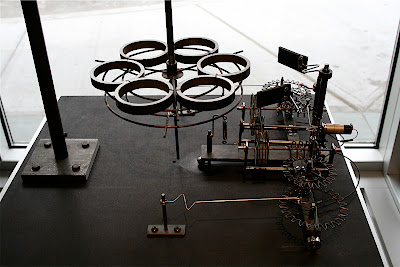
The kinematic sculptures of Arthur Ganson was a usual treat. The photo above is of a rather haunting piece named "Alone" where the complex gear network below causes the figurine to slowly move away (or towards) the edge.


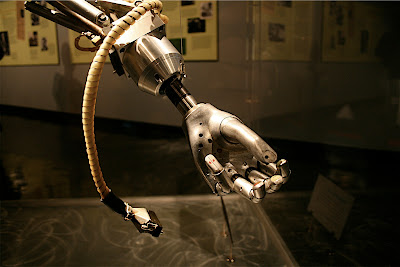
The arm above, known as "Minsky Arm," was the second arm developed by Marvin Minsky and Seymour Papert in a several year project to develop a computer which could see and interact with objects independent of human control. The amount of humanity which was instilled in its craftsmanship, is truly amazing. The relaxed state of the arm feels graceful and beautiful to me, as if I were admiring some fresco in the Vatican.


The self-oiling sculpture is one of my favorites of Ganson's. This machine is able to maintain itself, feed itself oil, it features of the complex self-referential process of homeostasis that distinguishes living things from the normally robotic.


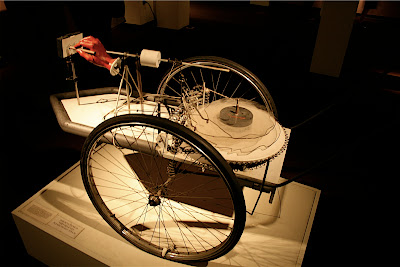
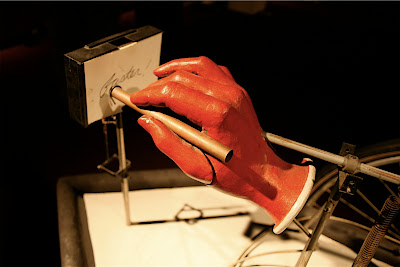
This push cart seems to be an incredible satire on the constant rush and desire to get ahead and today's materialistic capitalist world. It is built like a heavy-duty baby carriage (or "pram" for you British) that writes out a message on a piece of paper as you push it. On closer inspection (below) the message is the instruction "faster!" This is just another example of the sort of recursive self-creating art that I've grown to appreciate.


Upon disembarking from the MIT Museum, I felt my photo-taking hunger was not satisfied. I then remembered this crazy house on Brookline that I've been meaning to document for several months now.


The house is this wonderfully strange purple reminder of "cosmic consciousness" and the sort of playful insight gained and distributed by the "Beautiful People" of the 60s and 70s. This island in Cambridge remains. The slideshow above will give you a feel for the house, but I was very careful to document the whole fence and have uploaded the original size. Feel free to zoom in on the photos in my picasaweb and examine the detailed sayings on the fence. Please be patient as each photo is nearly 5mb in size, but the tapestry of this fence's wisdom is worth the wait. Some of my favorite nuggets are: "Serious Governments always fail", "The Cosmic Goose", "use of paraphenomenal abilities is a normal capacity among all advanced Galactic Civilizations, but Hyperspace is the frosting on the cake", "Twosday is Primeval, the egg is weavel", "competition Vs. Producing things which are cosmically beautiful", "generally speaking disorderly terrain reflects the truest Reality", the list just goes on. But what is this house? I don't know. It claims to be the "Center for Intergalactic Fragmentational Revurberations", but when I told my parents that I was applying there for graduate school they seemed suspicious. Perhaps the "National Defense Center Against Leaders: you're in charge" would be more pleasing to their palate, I think not.

IMG_0523.JPG

Leaving the house of "Cosmic Structure" behind, I had to refuel. So coffee and pastries were in order. This gorgeous middle eastern restaurant and hooka bar, certainly filled the bill.

IMG_0533.JPG

I did a random walk through west Cambridge before ending up in Harvard Square, where the alcohol-free, Puritanical verson of Oktoberfest was being held. Aside from my encounter with a giant bunny rabbit in a suit, the event was pretty tame.

IMG_0551.JPG

Perhaps it was the non-alcoholic beer I had, or some suspect sausage, everything started to take on funny colors, so I decided to head home. Fortunately, heading home, my camera agreed with my altered state. At least it made for beautiful pictures. I hope you enjoy my subjective take on reality!

IMG_0556.JPG
IMG_0558.JPG
IMG_0557.JPG