Just a quick break from doing research for my 21W.775 paper:
Joanna Macy is a buddhist with a serious interest in deep ecology and environmentalism. Her doctoral thesis involved a synthesis of general systems theory with Buddhist thinking. The publication Mutual Causality in Buddhism and General Systems Theory: The Dharma of Natural Systems looks like an interesting read.
Alright, back to work.
Saturday, October 27, 2007


Saturday, October 20, 2007
Deep Ecology
Hello and welcome again to Justin's endless effort to procrastinate less interesting work in favor of the quest for insight!
My 21W.775 - Writing about Nature and Environmental Issues, is the first humanities class I've taken at MIT that is NOT a philosophy class. Believe me ladies and gentlemen, that I would have never ventured outside the lofty domains of Course 24 - Philosophy and Linguistics, is it hadn't been for the wretched "HASS-D" requirement of MIT, that requires that I explore at least 3 flavors of the same ice cream: Humanities, Arts, and Social Sciences.
What have I done to negotiate this forced exposure to other fields? Crafted the class into my own philosophy course of course! So far I've successfully been able to dictate my own philosophical-personal style of writing and have been received warmly. For an upcoming 10-12 page research paper, we've been asked to investigate some environmental issue of something relating to this area. My chosen topic is the Environmental Ethics of Zen Buddhism. Ha! Take that for forcing me to follow an assignment!
In my search for references, I actually came across a very good book by the name of "Zen Buddhism and Environmental Ethics" by Simon P. James. In my first pass of the book, I ran across this notion of "Deep Ecology" which asserts that our current environmental crisis cannot be solved by the application of more science and technology. Rather it requires a deep shift in western consciousness in how we view our place in nature. Apparently one of the first proponents of this idea was Lynn White a professor in Medieval History who in a 1967 issue of Science, wrote "The Historical Roots of Our Ecologic Crisis".
In White's essay I've found a interesting analysis of the psychological foundations for our current relationship with the environment. Upon first reading I became convinced that it was one of the direct influences on Daniel Quinn's amazing book Ishmael.
The underlying idea is that the roots of modern science lie inside a Christian world view, which focuses on Man's quest to dominate, understand and subvert nature. The closing of the class gap has put the need and desire for technology in touch with the higher pursuits of pure science. Like gasoline on a fire, we've exploded in capability and population as a result of this, and even though the concerns of over-population and the environment are relatively new ones, we've been sowing the seeds of our destruction for hundreds of years.
As a beginning we should try to clarify our thinking by looking, in some historical depth, at the presuppositions that underlie modern technology and science. Science was traditionally aristocratic, speculative, intellectual in intent; technology was lower-class, empirical, action-oriented. The quite sudden fusion of these two, towards the middle of the 19th century, is surely related to the slightly prior and contemporary democratic revolutions which, by reducing social barriers, tended to assert a functional unity of brain and hand. Our ecologic crisis is the product of an emerging, entirely novel, democratic culture. The issue is whether a democratized world can survive its own implications. Presumably we cannot unless we rethink our axioms.
One of the things which struck me about this excerpt is the striking resemblance of "brain and hand" with MIT's slogan "Mens et Manus" -- "Mind and Hand."
Especially in its Western form, Christianity is the most anthropocentric religion the world has seen. As early as the 2nd century both Tertullian and Saint Irenaeus of Lyons were insisting that when God shaped Adam he was foreshadowing the image of the incarnate Christ, the Second Adam. Man shares, in great measure, God's transcendence of nature. Christianity, in absolute contrast to ancient paganism and Asia's religions (except, perhaps, Zorastrianism), not only established a dualism of man and nature but also insisted that it is God's will that man exploit nature for his proper ends.
At the level of the common people this worked out in an interesting way. In Antiquity every tree, every spring, every stream, every hill had its own genius loci, its guardian spirit. These spirits were accessible to men, but were very unlike men; centaurs, fauns, and mermaids show their ambivalence. Before one cut a tree, mined a mountain, or dammed a brook, it was important to placate the spirit in charge of that particular situation, and to keep it placated. By destroying pagan animism, Christianity made it possible to exploit nature in a mood of indifference to the feelings of natural objects.
And some people wonder why I'm a pagan.
The Greeks believed that sin was intellectual blindness, and that salvation was found in illumination, orthodoxy--that is, clear thinking. The Latins, on the other hand, felt that sin was moral evil, and that salvation was to be found in right conduct. Eastern theology has been intellectualist. Western theology has been voluntarist. The Greek saint contemplates; the Western saint acts. The implications of Christianity for the conquest of nature would emerge more easily in the Western atmosphere.
I was not aware of this divide even within the church. I suppose it goes to show what an evolving, self-selecting entity religion can be. It also points to why it so hard to say matter-of-factly "I am Christian." What breed of Christian? What time and place of Christianity are you referring to? In many ways, I find the gnostic and early Christian ideas incredibly interesting. I might even say I'd believe in some of their ideas, but it seems frightening to me to then say that I am Christian.
But since God had made nature, nature also must reveal the divine mentality. The religious study of nature for the better understanding of God was known as natural theology. In the early Church, and always in the Greek East, nature was conceived primarily as a symbolic system through which God speaks to men: the ant is a sermon to sluggards; rising flames are the symbol of the soul's aspiration. The view of nature was essentially artistic rather than scientific.
Ditto. Then enters the big bad Latin West --
However, in the Latin West by the early 13th century natural theology was following a very different bent. It was ceasing to be the decoding of the physical symbols of God's communication with man and was becoming the effort to understand God's mind by discovering how his creation operates. The rainbow was no longer simply a symbol of hope first sent to Noah after the Deluge: Robert Grosseteste, Friar Roger Bacon, and Theodoric of Freiberg produced startlingly sophisticated work on the optics of the rainbow, but they did it as a venture in religious understanding. From the 13th century onward, up to and including Leibnitz and Newton, every major scientist, in effect, explained his motivations in religious terms. Indeed, if Galileo had not been so expert an amateur theologian he would have got into far less trouble: the professionals resented his intrusion. And Newton seems to have regarded himself more as a theologian than as a scientist. It was not until the late 18th century that the hypothesis of God became unnecessary to many scientists.
The hypothesis may now be unnecessary, but the view of conquest and understanding remains.
If so, then modern Western science was cast in a matrix of Christian theology.
Professor White, then brings us the bad news:
I personally doubt that disastrous ecologic backlash can be avoided simply by applying to our problems more science and more technology. Our science and technology have grown out of Christian attitudes toward man's relation to nature which are almost universally held not only by Christians and neo-Christians but also by those who fondly regard themselves as post-Christians. Despite Copernicus, all the cosmos rotates around our little globe. Despite Darwin, we are not, in our hearts, part of the natural process. We are superior to nature, contemptuous of it, willing to use it for our slightest whim.
I can only hope that he is wrong, and there are some indications that he is wrong. The environmental movement spurred by essays like this one have reached the shores of scientists and politicians and (some of us) are working fast to correct our poor steering of the past few centuries. The human mind has produced some incredible good and I am optimistic enough to think that we will develop some brilliant inventions to reduce our impact on this world and stabilize our place on this little blue marble.
I have no doubt that life on Earth will survive until our solar system suffers from a cold death in a few billion years, it is only a question of whether or not humans will outlast the next few centuries.
What I envision is a scientific-enlightened citizenry that adopts some of the more buddhist and animist ways of thinking, in an effort to live in harmony with other life on Earth. By wedding mind and hand, we did more than we knew better to do, but our consciousness is catching up with our capabilities and I can only hope that a wedding of mind and spirit will be able right the wrongs of the past.
My 21W.775 - Writing about Nature and Environmental Issues, is the first humanities class I've taken at MIT that is NOT a philosophy class. Believe me ladies and gentlemen, that I would have never ventured outside the lofty domains of Course 24 - Philosophy and Linguistics, is it hadn't been for the wretched "HASS-D" requirement of MIT, that requires that I explore at least 3 flavors of the same ice cream: Humanities, Arts, and Social Sciences.
What have I done to negotiate this forced exposure to other fields? Crafted the class into my own philosophy course of course! So far I've successfully been able to dictate my own philosophical-personal style of writing and have been received warmly. For an upcoming 10-12 page research paper, we've been asked to investigate some environmental issue of something relating to this area. My chosen topic is the Environmental Ethics of Zen Buddhism. Ha! Take that for forcing me to follow an assignment!
In my search for references, I actually came across a very good book by the name of "Zen Buddhism and Environmental Ethics" by Simon P. James. In my first pass of the book, I ran across this notion of "Deep Ecology" which asserts that our current environmental crisis cannot be solved by the application of more science and technology. Rather it requires a deep shift in western consciousness in how we view our place in nature. Apparently one of the first proponents of this idea was Lynn White a professor in Medieval History who in a 1967 issue of Science, wrote "The Historical Roots of Our Ecologic Crisis".
In White's essay I've found a interesting analysis of the psychological foundations for our current relationship with the environment. Upon first reading I became convinced that it was one of the direct influences on Daniel Quinn's amazing book Ishmael.
The underlying idea is that the roots of modern science lie inside a Christian world view, which focuses on Man's quest to dominate, understand and subvert nature. The closing of the class gap has put the need and desire for technology in touch with the higher pursuits of pure science. Like gasoline on a fire, we've exploded in capability and population as a result of this, and even though the concerns of over-population and the environment are relatively new ones, we've been sowing the seeds of our destruction for hundreds of years.
As a beginning we should try to clarify our thinking by looking, in some historical depth, at the presuppositions that underlie modern technology and science. Science was traditionally aristocratic, speculative, intellectual in intent; technology was lower-class, empirical, action-oriented. The quite sudden fusion of these two, towards the middle of the 19th century, is surely related to the slightly prior and contemporary democratic revolutions which, by reducing social barriers, tended to assert a functional unity of brain and hand. Our ecologic crisis is the product of an emerging, entirely novel, democratic culture. The issue is whether a democratized world can survive its own implications. Presumably we cannot unless we rethink our axioms.
One of the things which struck me about this excerpt is the striking resemblance of "brain and hand" with MIT's slogan "Mens et Manus" -- "Mind and Hand."
Especially in its Western form, Christianity is the most anthropocentric religion the world has seen. As early as the 2nd century both Tertullian and Saint Irenaeus of Lyons were insisting that when God shaped Adam he was foreshadowing the image of the incarnate Christ, the Second Adam. Man shares, in great measure, God's transcendence of nature. Christianity, in absolute contrast to ancient paganism and Asia's religions (except, perhaps, Zorastrianism), not only established a dualism of man and nature but also insisted that it is God's will that man exploit nature for his proper ends.
At the level of the common people this worked out in an interesting way. In Antiquity every tree, every spring, every stream, every hill had its own genius loci, its guardian spirit. These spirits were accessible to men, but were very unlike men; centaurs, fauns, and mermaids show their ambivalence. Before one cut a tree, mined a mountain, or dammed a brook, it was important to placate the spirit in charge of that particular situation, and to keep it placated. By destroying pagan animism, Christianity made it possible to exploit nature in a mood of indifference to the feelings of natural objects.
And some people wonder why I'm a pagan.
The Greeks believed that sin was intellectual blindness, and that salvation was found in illumination, orthodoxy--that is, clear thinking. The Latins, on the other hand, felt that sin was moral evil, and that salvation was to be found in right conduct. Eastern theology has been intellectualist. Western theology has been voluntarist. The Greek saint contemplates; the Western saint acts. The implications of Christianity for the conquest of nature would emerge more easily in the Western atmosphere.
I was not aware of this divide even within the church. I suppose it goes to show what an evolving, self-selecting entity religion can be. It also points to why it so hard to say matter-of-factly "I am Christian." What breed of Christian? What time and place of Christianity are you referring to? In many ways, I find the gnostic and early Christian ideas incredibly interesting. I might even say I'd believe in some of their ideas, but it seems frightening to me to then say that I am Christian.
But since God had made nature, nature also must reveal the divine mentality. The religious study of nature for the better understanding of God was known as natural theology. In the early Church, and always in the Greek East, nature was conceived primarily as a symbolic system through which God speaks to men: the ant is a sermon to sluggards; rising flames are the symbol of the soul's aspiration. The view of nature was essentially artistic rather than scientific.
Ditto. Then enters the big bad Latin West --
However, in the Latin West by the early 13th century natural theology was following a very different bent. It was ceasing to be the decoding of the physical symbols of God's communication with man and was becoming the effort to understand God's mind by discovering how his creation operates. The rainbow was no longer simply a symbol of hope first sent to Noah after the Deluge: Robert Grosseteste, Friar Roger Bacon, and Theodoric of Freiberg produced startlingly sophisticated work on the optics of the rainbow, but they did it as a venture in religious understanding. From the 13th century onward, up to and including Leibnitz and Newton, every major scientist, in effect, explained his motivations in religious terms. Indeed, if Galileo had not been so expert an amateur theologian he would have got into far less trouble: the professionals resented his intrusion. And Newton seems to have regarded himself more as a theologian than as a scientist. It was not until the late 18th century that the hypothesis of God became unnecessary to many scientists.
The hypothesis may now be unnecessary, but the view of conquest and understanding remains.
If so, then modern Western science was cast in a matrix of Christian theology.
Professor White, then brings us the bad news:
I personally doubt that disastrous ecologic backlash can be avoided simply by applying to our problems more science and more technology. Our science and technology have grown out of Christian attitudes toward man's relation to nature which are almost universally held not only by Christians and neo-Christians but also by those who fondly regard themselves as post-Christians. Despite Copernicus, all the cosmos rotates around our little globe. Despite Darwin, we are not, in our hearts, part of the natural process. We are superior to nature, contemptuous of it, willing to use it for our slightest whim.
I can only hope that he is wrong, and there are some indications that he is wrong. The environmental movement spurred by essays like this one have reached the shores of scientists and politicians and (some of us) are working fast to correct our poor steering of the past few centuries. The human mind has produced some incredible good and I am optimistic enough to think that we will develop some brilliant inventions to reduce our impact on this world and stabilize our place on this little blue marble.
I have no doubt that life on Earth will survive until our solar system suffers from a cold death in a few billion years, it is only a question of whether or not humans will outlast the next few centuries.
What I envision is a scientific-enlightened citizenry that adopts some of the more buddhist and animist ways of thinking, in an effort to live in harmony with other life on Earth. By wedding mind and hand, we did more than we knew better to do, but our consciousness is catching up with our capabilities and I can only hope that a wedding of mind and spirit will be able right the wrongs of the past.
Tuesday, October 9, 2007
R&R After a Week of Hell
I have to confess it. This past week was one of the most grueling, exhausting, and all around depressing weeks I've ever experienced as an undergraduate. One of those weeks where you say to yourself before hand, this is going to be one of the most preposterous weeks you'll ever experience and somehow when you're actually in the middle of it, you forget those words of caution that you gave yourself. There were times when I felt like my hopes and ambitions to become a mathematician were crumbling down around me and that I was going to have to give it all up and figure out something else to do. When the going was at its toughest, perspective was just something I couldn't have.
I'm recovering from that slump, and most of it can be attributed to having a 4-day weekend and spending my first day in a long time where I did absolutely NO work. A truly amazing feeling, I almost forgot what it was like. So what did I do with my day of rest and relaxation you might ask? I took pictures of course!
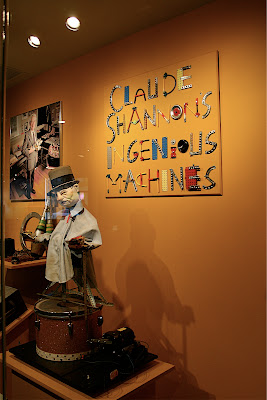
The MIT Museum has recently had a "Grand Re-Opening" and introduced several new exhibits including several technical toys from the personal collection of Claude Shannon, information theorist extraordinaire.
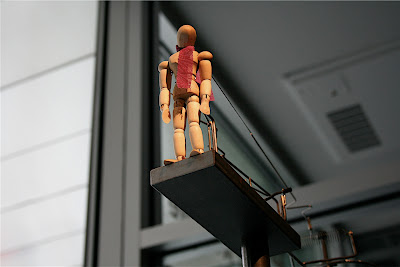
The kinematic sculptures of Arthur Ganson was a usual treat. The photo above is of a rather haunting piece named "Alone" where the complex gear network below causes the figurine to slowly move away (or towards) the edge.
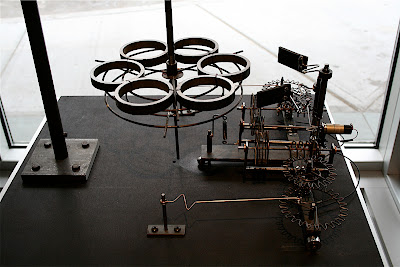
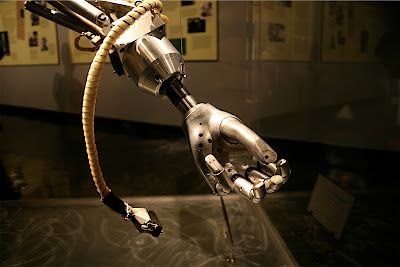
The arm above, known as "Minsky Arm," was the second arm developed by Marvin Minsky and Seymour Papert in a several year project to develop a computer which could see and interact with objects independent of human control. The amount of humanity which was instilled in its craftsmanship, is truly amazing. The relaxed state of the arm feels graceful and beautiful to me, as if I were admiring some fresco in the Vatican.
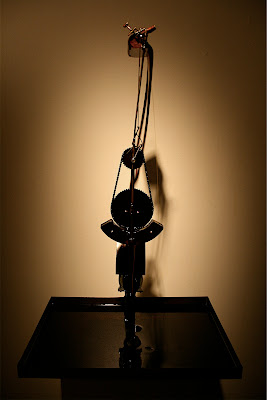
The self-oiling sculpture is one of my favorites of Ganson's. This machine is able to maintain itself, feed itself oil, it features of the complex self-referential process of homeostasis that distinguishes living things from the normally robotic.
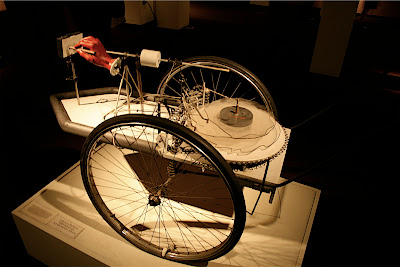
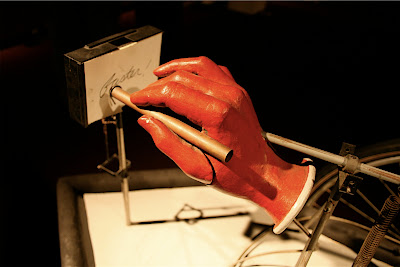
This push cart seems to be an incredible satire on the constant rush and desire to get ahead and today's materialistic capitalist world. It is built like a heavy-duty baby carriage (or "pram" for you British) that writes out a message on a piece of paper as you push it. On closer inspection (below) the message is the instruction "faster!" This is just another example of the sort of recursive self-creating art that I've grown to appreciate.
Upon disembarking from the MIT Museum, I felt my photo-taking hunger was not satisfied. I then remembered this crazy house on Brookline that I've been meaning to document for several months now.
The house is this wonderfully strange purple reminder of "cosmic consciousness" and the sort of playful insight gained and distributed by the "Beautiful People" of the 60s and 70s. This island in Cambridge remains. The slideshow above will give you a feel for the house, but I was very careful to document the whole fence and have uploaded the original size. Feel free to zoom in on the photos in my picasaweb and examine the detailed sayings on the fence. Please be patient as each photo is nearly 5mb in size, but the tapestry of this fence's wisdom is worth the wait. Some of my favorite nuggets are: "Serious Governments always fail", "The Cosmic Goose", "use of paraphenomenal abilities is a normal capacity among all advanced Galactic Civilizations, but Hyperspace is the frosting on the cake", "Twosday is Primeval, the egg is weavel", "competition Vs. Producing things which are cosmically beautiful", "generally speaking disorderly terrain reflects the truest Reality", the list just goes on. But what is this house? I don't know. It claims to be the "Center for Intergalactic Fragmentational Revurberations", but when I told my parents that I was applying there for graduate school they seemed suspicious. Perhaps the "National Defense Center Against Leaders: you're in charge" would be more pleasing to their palate, I think not.

Leaving the house of "Cosmic Structure" behind, I had to refuel. So coffee and pastries were in order. This gorgeous middle eastern restaurant and hooka bar, certainly filled the bill.

I did a random walk through west Cambridge before ending up in Harvard Square, where the alcohol-free, Puritanical verson of Oktoberfest was being held. Aside from my encounter with a giant bunny rabbit in a suit, the event was pretty tame.

Perhaps it was the non-alcoholic beer I had, or some suspect sausage, everything started to take on funny colors, so I decided to head home. Fortunately, heading home, my camera agreed with my altered state. At least it made for beautiful pictures. I hope you enjoy my subjective take on reality!


I'm recovering from that slump, and most of it can be attributed to having a 4-day weekend and spending my first day in a long time where I did absolutely NO work. A truly amazing feeling, I almost forgot what it was like. So what did I do with my day of rest and relaxation you might ask? I took pictures of course!
The MIT Museum has recently had a "Grand Re-Opening" and introduced several new exhibits including several technical toys from the personal collection of Claude Shannon, information theorist extraordinaire.
The kinematic sculptures of Arthur Ganson was a usual treat. The photo above is of a rather haunting piece named "Alone" where the complex gear network below causes the figurine to slowly move away (or towards) the edge.
The arm above, known as "Minsky Arm," was the second arm developed by Marvin Minsky and Seymour Papert in a several year project to develop a computer which could see and interact with objects independent of human control. The amount of humanity which was instilled in its craftsmanship, is truly amazing. The relaxed state of the arm feels graceful and beautiful to me, as if I were admiring some fresco in the Vatican.
The self-oiling sculpture is one of my favorites of Ganson's. This machine is able to maintain itself, feed itself oil, it features of the complex self-referential process of homeostasis that distinguishes living things from the normally robotic.
This push cart seems to be an incredible satire on the constant rush and desire to get ahead and today's materialistic capitalist world. It is built like a heavy-duty baby carriage (or "pram" for you British) that writes out a message on a piece of paper as you push it. On closer inspection (below) the message is the instruction "faster!" This is just another example of the sort of recursive self-creating art that I've grown to appreciate.
Upon disembarking from the MIT Museum, I felt my photo-taking hunger was not satisfied. I then remembered this crazy house on Brookline that I've been meaning to document for several months now.
The house is this wonderfully strange purple reminder of "cosmic consciousness" and the sort of playful insight gained and distributed by the "Beautiful People" of the 60s and 70s. This island in Cambridge remains. The slideshow above will give you a feel for the house, but I was very careful to document the whole fence and have uploaded the original size. Feel free to zoom in on the photos in my picasaweb and examine the detailed sayings on the fence. Please be patient as each photo is nearly 5mb in size, but the tapestry of this fence's wisdom is worth the wait. Some of my favorite nuggets are: "Serious Governments always fail", "The Cosmic Goose", "use of paraphenomenal abilities is a normal capacity among all advanced Galactic Civilizations, but Hyperspace is the frosting on the cake", "Twosday is Primeval, the egg is weavel", "competition Vs. Producing things which are cosmically beautiful", "generally speaking disorderly terrain reflects the truest Reality", the list just goes on. But what is this house? I don't know. It claims to be the "Center for Intergalactic Fragmentational Revurberations", but when I told my parents that I was applying there for graduate school they seemed suspicious. Perhaps the "National Defense Center Against Leaders: you're in charge" would be more pleasing to their palate, I think not.
Leaving the house of "Cosmic Structure" behind, I had to refuel. So coffee and pastries were in order. This gorgeous middle eastern restaurant and hooka bar, certainly filled the bill.
I did a random walk through west Cambridge before ending up in Harvard Square, where the alcohol-free, Puritanical verson of Oktoberfest was being held. Aside from my encounter with a giant bunny rabbit in a suit, the event was pretty tame.
Perhaps it was the non-alcoholic beer I had, or some suspect sausage, everything started to take on funny colors, so I decided to head home. Fortunately, heading home, my camera agreed with my altered state. At least it made for beautiful pictures. I hope you enjoy my subjective take on reality!
Monday, September 24, 2007
A (Photographic) Day in the Life
The Day is gone and I have a tale to tell, of a three day weekend from a week of hell!

Like any good morning it started with seeing Sasha through fresh eyes as we both woke up early to jump start the day.

Of course there is no better way to kick start one's day than with a nice big breakfast at Sunny's Diner.

Once I had ate my fair share of delicious dark rye toast, over hard eggs with hot sauce and sausage, I made my way to my task for the day: Psychology lab studies. Yes my friend, I was selling myself for 6.5 hours that day for $100 and pizza so that the people at the big blue building in the sky could pick my brain and collect their data. I really should have been working, but $100 and free pizza was hard to dismiss.

I was running late for the "prompt 10am start" of the study, but I had to pause and enjoy the sight of the Stata and its crumpled colorful glory.

Oh Stata! What will your slanted confusion deliver us?! What genius lurks in your fantastic folds?!

Alas! My moment of genuflection had gone on too long. I entered the mouth of Stata's baby brother across the way: Building 46.
Once inside the monster's mouth, I was grabbed by men in white coats and subjected to horrors untellable to any decent person. Transcribing minute sound clips into their phonetic spellings for nearly 5 hours is enough for any man to lose his mind, but I am an MIT student! And with my Obsessive Compulsive Disorder Powers I foiled my assailants and took pleasure in the painstaking detail of my task! Take that you formidable foes of psychoacoustics! Now where's my $100?
"That'll be sent to you in the next 4 to 6 weeks."
Damn you bureaucracy and your molasses-like speed and methods! I'll get you one day!

Finally released from my captors with a few extra pieces attached and some other ones missing, I paused to contemplate Frank Gehry's own obvious product of hallucination and I began to wonder what Ken Kesey government funded psychiatric hospital he frequented to pay his way through grad school.

But wait! Before I bade goodbye to the building in the sky I had to document my surroundings. They say this atrium was designed to promote interaction of psychologists, cognitive scientists, and neuroscientists. As you can see, it was very popular on this Sunday afternoon.

Approaching the windows to the left, I gazed out over the train tracks that split the building in two. Everyone thought it was such a clever idea to build over the train tracks. That's right! Don't box me in! I'll build whatever I want, wherever I want! Now I hear that the rumbling of the passing trains is trashing the results of the very delicate MRI equipment located in some of the labs here. Oh well...

Good bye great atrium! I wish you Godspeed in your facilitation of interaction in the Revolution of Brain and Cognitive Science sure to come!

On my way out I caught a glance of the main sign warning off invaders. I thought the piece of art to the right was telling: "Welcome to the Brain and Cognitive Sciences Department, If you have loose wires in your head, you've found the right place!"

The study's effects were wearing on me. I had to make a quick duck through MIT to find coffee. Time was running out! I needed caffeine!!!!

Damn it! Something interesting was on a light post as I attempted to rush by in the pursuit of that dark liqueur of life. Chromosome Two?!?! Ahhh... The Genome Trail! Like its own Oregon Trail, there is gold in these rivers of biotechnology waiting to be panned. Let's all rush to the frontier!

After locating an Au Bon Pain and injecting iced coffee directly into my veins, I sat in the afterglow of the moment, admiring the sunny dance of colors in Cambridge's Kendall Square.

Now that I was rejuvenated I could explore! Wandering towards Boston-side, I happened upon an old friend of mine named "Galaxy". Ah, the wonderful conversations I've had by this fountain! Thank you fountain, but I must be on my way!

I began to cross Longfellow bridge in eager anticipation of the wonderful sights in the middle of its mighty span. Rusted green decor of European persuasion, guide me to your center!

The sights are too beautiful and too numerous. I must take pictures! Boats! Water! Boston! How I love thee!
I kept snapping photo upon photo. Aha! Take that world, as I steal your beauty with my lens! I continued to rush to the center of the bridge and finally framed what was to be the photo of the day. "Change Battery Pack" greeted me on the large LCD and I started to cry. Damn you Lithium Ion batteries! If only I had brought my battery grip! Sigh...

I quickly counseled myself, because I knew I had friends waiting for me at home (and new batteries). Hello Emerson dear! Good Evening, Hatcher Honey! Did the toilet paper keep you warm while I was gone? Hatcher, did you drink the rest of my coke?!?

The sun was setting and I decided that my camera could capture drapery better than I could draw.

Oh glorious, industrial Cambridge! Your sunsets mock the apocalyptic skies of Hiroshima!
If only your crime rate weren't so high and your construction so loud...

My day was done and bed awaited my tired body and probed mind. But before I embarked on that evening's study of oneirology (the study of dreams), I had to prepare for my night with a little bedtime story. I began to read immediately "Once upon a time there was a CW complex that...", but my eyes became heavy and there was no more story to tell of the three day weekend from a week of hell.
Like any good morning it started with seeing Sasha through fresh eyes as we both woke up early to jump start the day.
Of course there is no better way to kick start one's day than with a nice big breakfast at Sunny's Diner.
Once I had ate my fair share of delicious dark rye toast, over hard eggs with hot sauce and sausage, I made my way to my task for the day: Psychology lab studies. Yes my friend, I was selling myself for 6.5 hours that day for $100 and pizza so that the people at the big blue building in the sky could pick my brain and collect their data. I really should have been working, but $100 and free pizza was hard to dismiss.
I was running late for the "prompt 10am start" of the study, but I had to pause and enjoy the sight of the Stata and its crumpled colorful glory.
Oh Stata! What will your slanted confusion deliver us?! What genius lurks in your fantastic folds?!
Alas! My moment of genuflection had gone on too long. I entered the mouth of Stata's baby brother across the way: Building 46.
Once inside the monster's mouth, I was grabbed by men in white coats and subjected to horrors untellable to any decent person. Transcribing minute sound clips into their phonetic spellings for nearly 5 hours is enough for any man to lose his mind, but I am an MIT student! And with my Obsessive Compulsive Disorder Powers I foiled my assailants and took pleasure in the painstaking detail of my task! Take that you formidable foes of psychoacoustics! Now where's my $100?
"That'll be sent to you in the next 4 to 6 weeks."
Damn you bureaucracy and your molasses-like speed and methods! I'll get you one day!
Finally released from my captors with a few extra pieces attached and some other ones missing, I paused to contemplate Frank Gehry's own obvious product of hallucination and I began to wonder what Ken Kesey government funded psychiatric hospital he frequented to pay his way through grad school.
But wait! Before I bade goodbye to the building in the sky I had to document my surroundings. They say this atrium was designed to promote interaction of psychologists, cognitive scientists, and neuroscientists. As you can see, it was very popular on this Sunday afternoon.
Approaching the windows to the left, I gazed out over the train tracks that split the building in two. Everyone thought it was such a clever idea to build over the train tracks. That's right! Don't box me in! I'll build whatever I want, wherever I want! Now I hear that the rumbling of the passing trains is trashing the results of the very delicate MRI equipment located in some of the labs here. Oh well...
Good bye great atrium! I wish you Godspeed in your facilitation of interaction in the Revolution of Brain and Cognitive Science sure to come!
On my way out I caught a glance of the main sign warning off invaders. I thought the piece of art to the right was telling: "Welcome to the Brain and Cognitive Sciences Department, If you have loose wires in your head, you've found the right place!"
The study's effects were wearing on me. I had to make a quick duck through MIT to find coffee. Time was running out! I needed caffeine!!!!
Damn it! Something interesting was on a light post as I attempted to rush by in the pursuit of that dark liqueur of life. Chromosome Two?!?! Ahhh... The Genome Trail! Like its own Oregon Trail, there is gold in these rivers of biotechnology waiting to be panned. Let's all rush to the frontier!
After locating an Au Bon Pain and injecting iced coffee directly into my veins, I sat in the afterglow of the moment, admiring the sunny dance of colors in Cambridge's Kendall Square.
Now that I was rejuvenated I could explore! Wandering towards Boston-side, I happened upon an old friend of mine named "Galaxy". Ah, the wonderful conversations I've had by this fountain! Thank you fountain, but I must be on my way!
I began to cross Longfellow bridge in eager anticipation of the wonderful sights in the middle of its mighty span. Rusted green decor of European persuasion, guide me to your center!
The sights are too beautiful and too numerous. I must take pictures! Boats! Water! Boston! How I love thee!
I kept snapping photo upon photo. Aha! Take that world, as I steal your beauty with my lens! I continued to rush to the center of the bridge and finally framed what was to be the photo of the day. "Change Battery Pack" greeted me on the large LCD and I started to cry. Damn you Lithium Ion batteries! If only I had brought my battery grip! Sigh...
I quickly counseled myself, because I knew I had friends waiting for me at home (and new batteries). Hello Emerson dear! Good Evening, Hatcher Honey! Did the toilet paper keep you warm while I was gone? Hatcher, did you drink the rest of my coke?!?
The sun was setting and I decided that my camera could capture drapery better than I could draw.
Oh glorious, industrial Cambridge! Your sunsets mock the apocalyptic skies of Hiroshima!
If only your crime rate weren't so high and your construction so loud...
My day was done and bed awaited my tired body and probed mind. But before I embarked on that evening's study of oneirology (the study of dreams), I had to prepare for my night with a little bedtime story. I began to read immediately "Once upon a time there was a CW complex that...", but my eyes became heavy and there was no more story to tell of the three day weekend from a week of hell.
Thursday, September 20, 2007
First Day Rebel


My Digital SLR the Canon Rebel XTi came finally! I really feel like the power in my hands outstretches my capability. But I look forward to learning! Check out my first day highlights. They are largely full auto, but I look forward to playing with the full features very soon!
Emerson and the American Transcedentalist
As part of my coursework in 21W.775 (Writing about Nature and Environmental Issues), we've started reading Ralph Waldo Emerson's first serious work "Nature." Upon reading the first half, I'm completely blown away at the ideas that Emerson was turned onto way back in 1836. I quote:
"Whenever a true theory appears, it will be its own evidence. Its test is, that it will explain all phenomena" (P. 3)
ALL PHENOMENA?!?!?!?
So maybe he's reaching a little bit there, and really can't hope for such lofty goals. Does Emerson tuck his tail between his legs and step down a few layers of transcendental abstraction? Hardly...
"Standing on the bare ground -- my head bathed by the blithe air and uplifted into infinite space -- all mean egotism vanishes. I become a transparent eyeball; I am nothing; I see all; the currents of the Universal Being circulate through me; I am part or parcel of God." (p. 6)
I became a transparent eyeball... At this point of reading the essay, I was expecting Allen Ginsburg and Ram Dass to come skipping over the hillsides to join Emerson, chanting "Hare Krishna, Hare, Hare..." while The Grateful Dead and Jefferson Airplane are helping Thoreau outfit his cabin with the latest and greatest stroboscopic lights and audio feedback effects.
But seriously, Emerson seems totally turned onto a whole way of thinking, that seems culturally disconnected from him. At times his musings seem almost painfully and obviously Buddhist in nature.
"Who looks upon a river in a meditative hour and is not reminded of the flux of all things?" (p. 14)
The answer, Emerson buddy pal, is pretty much the majority of Western Civilization isn't reminded of the impermanence of all things. At times when reading Emerson, I find it hard to believe that this is a guy in Massachusetts and not some ambitious American monk taking up sanctuary in a Tibetan monastery.
The number of jewels of insight that Emerson packs into this sub 40 page essay truly is remarkable. I leave you with these few morsels, because otherwise I'd be quoting verbatim the entire work. The number of ideas that Emerson and his Transcendental Club seem tuned into a full 130 years before the counter-culture movement of the 1960s is suggestive that there is a rich tradition to be explored here. That sense of longing that so many of us Western spiritual children of the East have by being misplaced physically in this wide world is quelled when we find a great grandfather of American literature spiritually and physically close to home.
"Whenever a true theory appears, it will be its own evidence. Its test is, that it will explain all phenomena" (P. 3)
ALL PHENOMENA?!?!?!?
So maybe he's reaching a little bit there, and really can't hope for such lofty goals. Does Emerson tuck his tail between his legs and step down a few layers of transcendental abstraction? Hardly...
"Standing on the bare ground -- my head bathed by the blithe air and uplifted into infinite space -- all mean egotism vanishes. I become a transparent eyeball; I am nothing; I see all; the currents of the Universal Being circulate through me; I am part or parcel of God." (p. 6)
I became a transparent eyeball... At this point of reading the essay, I was expecting Allen Ginsburg and Ram Dass to come skipping over the hillsides to join Emerson, chanting "Hare Krishna, Hare, Hare..." while The Grateful Dead and Jefferson Airplane are helping Thoreau outfit his cabin with the latest and greatest stroboscopic lights and audio feedback effects.
But seriously, Emerson seems totally turned onto a whole way of thinking, that seems culturally disconnected from him. At times his musings seem almost painfully and obviously Buddhist in nature.
"Who looks upon a river in a meditative hour and is not reminded of the flux of all things?" (p. 14)
The answer, Emerson buddy pal, is pretty much the majority of Western Civilization isn't reminded of the impermanence of all things. At times when reading Emerson, I find it hard to believe that this is a guy in Massachusetts and not some ambitious American monk taking up sanctuary in a Tibetan monastery.
The number of jewels of insight that Emerson packs into this sub 40 page essay truly is remarkable. I leave you with these few morsels, because otherwise I'd be quoting verbatim the entire work. The number of ideas that Emerson and his Transcendental Club seem tuned into a full 130 years before the counter-culture movement of the 1960s is suggestive that there is a rich tradition to be explored here. That sense of longing that so many of us Western spiritual children of the East have by being misplaced physically in this wide world is quelled when we find a great grandfather of American literature spiritually and physically close to home.
Tuesday, September 18, 2007
Royksopp - "Remind Me"
So this music video has infected my brain.
Sometimes I really hate being the victim of internet memes, but then again our internet has enabled small jewels of high quality to become easily identified and popularized. It makes me wonder how this has impacted business and the ability for the "little guy" just to speak out.
The advent and use of the internet has also enabled things like this blog to actually come to life. I had thought several years ago that it would be nice for there to just be an open online forum for discussion for my family and friends to post on and read each other's thoughts. This could offer glimpses into each of our own personal worlds and thus we can get to know each other in ways that normally wouldn't have been possible. Normal interaction has its pluses: Visual eye contact, body language, tone, mood, etc. Whole worlds of emotions are hidden in the text-based communication of the online world, and often this leads to misunderstanding, i.e. flamewars. However, that degree of impersonality and chance to actually just write for whoever wants to read, in many ways allows your loved ones to observe you externally.
I'd like to dub this the "Relationship-Schrodinger's-Cat-in-a-box" paradox. When we interact with people in a face-to-face manner, we learn to exaggerate certain aspects of our selves and suppress others. We cultivate separate images of ourselves for separate friends and groups of friends. Pretty much everyone does this. When guys are out to a pub with just the guys we can almost become more crude then we'd like to think of ourselves normally. Machismo and all those little bits of our person-hood come rushing to the surface. In new social situations, some of us dry up waiting for someone else to crack the ice, or some of us become the group jester, to help break the awkward silence. The bottom line is that we have these constants, these eigenstates of personality that certain people always observe us in.
The fascination that I have with my blogging experience is that there is this rare opportunity for different people to tune in and look inside this box of personality you've created. Weird things happen. Your parents can see you in a superposition of personalities which are both known and unknown. Certain friends can observe you talking about things which you may have never normally discussed with them. In some ways this may create stress, stress to keep your personal eigenstates separate for separate people, but I welcome the superposition. May it be insightful for everyone!
Sometimes I really hate being the victim of internet memes, but then again our internet has enabled small jewels of high quality to become easily identified and popularized. It makes me wonder how this has impacted business and the ability for the "little guy" just to speak out.
The advent and use of the internet has also enabled things like this blog to actually come to life. I had thought several years ago that it would be nice for there to just be an open online forum for discussion for my family and friends to post on and read each other's thoughts. This could offer glimpses into each of our own personal worlds and thus we can get to know each other in ways that normally wouldn't have been possible. Normal interaction has its pluses: Visual eye contact, body language, tone, mood, etc. Whole worlds of emotions are hidden in the text-based communication of the online world, and often this leads to misunderstanding, i.e. flamewars. However, that degree of impersonality and chance to actually just write for whoever wants to read, in many ways allows your loved ones to observe you externally.
I'd like to dub this the "Relationship-Schrodinger's-Cat-in-a-box" paradox. When we interact with people in a face-to-face manner, we learn to exaggerate certain aspects of our selves and suppress others. We cultivate separate images of ourselves for separate friends and groups of friends. Pretty much everyone does this. When guys are out to a pub with just the guys we can almost become more crude then we'd like to think of ourselves normally. Machismo and all those little bits of our person-hood come rushing to the surface. In new social situations, some of us dry up waiting for someone else to crack the ice, or some of us become the group jester, to help break the awkward silence. The bottom line is that we have these constants, these eigenstates of personality that certain people always observe us in.
The fascination that I have with my blogging experience is that there is this rare opportunity for different people to tune in and look inside this box of personality you've created. Weird things happen. Your parents can see you in a superposition of personalities which are both known and unknown. Certain friends can observe you talking about things which you may have never normally discussed with them. In some ways this may create stress, stress to keep your personal eigenstates separate for separate people, but I welcome the superposition. May it be insightful for everyone!
Subscribe to:
Posts (Atom)
